
Why a Clear Homeschool Daily Schedule Brings Peace

“Can I really do this?” I remember the question echoing in my mind on a cold January day, as I tried to manage my three very different children at once, one holding back tears in her math lesson, one zooming through her work, and a toddler running circles around the school table. I was ready to give up. It felt like we were in survival mode, and I just couldn’t seem to make our homeschool day work.
I felt deeply committed to homeschooling and was convicted that this way of education was important, but I was lacking a clear direction of how this would look in our home in a way that met the needs of three different children. The advice that I kept hearing was well-meaning, but vague: “Keep it simple! Do math and language arts, and then just let them read!”
A few weeks later, I attended a local Charlotte Mason retreat on a whim, longing for advice and wisdom with how to move forward. As I listened to the speakers, sat in immersion lessons, and picked the brains of other moms who were further along than I was, I realized that there was another way forward, and that this was the kind of education I wanted for my children.
As I began to unpack the Charlotte Mason method, one truth became clear to me: peace doesn’t come from doing less. It comes from resting in Christ, having a clear purpose, a wide and nourishing feast of ideas, and a clear structure for the day.
I will unpack some of these elements more later, but today I want to focus on that last piece. In may own experience, and in nearly every conversation I’ve had with overwhelmed homeschool moms, a lack of clear structure is the missing ingredient.
Children Need to Know What Comes Next
I know that as homeschoolers, we often wrestle with a tension between:
“Our homeschool doesn’t need to look the same as traditional school— we can be flexible!” and “I need more structure in our homeschool day.”
While homeschooling does allow for flexibility, children still thrive on predictability. When our children know what to expect, they feel secure. Resistance decreases. Attention improves. The day feels calmer for everyone.
Charlotte Mason understood this deeply and was adamant that every child have a clear “time-table” for their school day:
“In the first place, there is a time-table, written out fairly, so that the child knows what he has to do and how long each lesson is to last. The idea of definite work to be finished in a given time is valuable to the child, not only as training him in habits of order, but in diligence; he learns that one time is not ‘as good as another’; that there is no right time left for what is not done in its own time; and this knowledge alone does a great deal to secure the child’s attention to his work.” (Home Education, p. 142)
A homeschool daily schedule is not about control— rather, it is about cultivating habits of order, diligence, and attention.
Why Time-Based Schedules Often Fail
Initially, I attempted to build our schedule with strict time-of-day schedules:
8:30 Math
9:00 Reading
9:30 History, etc.
What I quickly discovered was that with children of multiple ages and needs, varying attention spans, and interruptions, those time stamps created unnecessary pressure. Instead of celebrating the work we had accomplished, I constantly fell behind..
The problem wasn’t structure—it was the type of structure.
The Charlotte Mason Homeschool Schedule
So now you’re asking,
“If structure matters, but time-based schedules don’t work, what’s the alternative?”
Is a time-table necessary? Absolutely. 100%. I would venture to say it is the single most essential ingredient to an effective homeschool day.
However, I’ve found that building a schedule around clear lesson lengths and a consistent order of subjects is both simple and powerful.
Here’s what this looks like in practice:
- Write out your time-table with a clear lesson length (For example, Math— 30 minutes instead of 8:30-9:00 Math).
- Label your days as Day 1, Day 2, Day 3, Day 4, Day 5 rather than Monday through Friday. This removes pressure when life interrupts and allows you to simply pick up where you left off.
- Have a very clear and consistent schedule for each day of the week so that children always know what comes next
- Plan individual schedules for each child ahead of time, accounting for independent work and one-on-one lessons.
- Make the schedule visible. A printed timetable for each child that is placed in their binder or on the wall allows children to take ownership of their work and reduces constant questions.
This structure brings clarity to your homeschool day without rigidity— and it works beautifully for families that are homeschooling multiple children.

What a “Clear” Homeschool Schedule Really Means
So what does it mean to have clear homeschool daily schedule?
- Lesson lengths are defined.
- The homeschool daily schedule each week is consistent and repeatable.
- The homeschool daily schedule for each child is visible and easy to follow.
What Do I Do Next?
Does the idea of creating a time-table for each child right now feel overwhelming? Take heart— you don’t have to do everything at once.
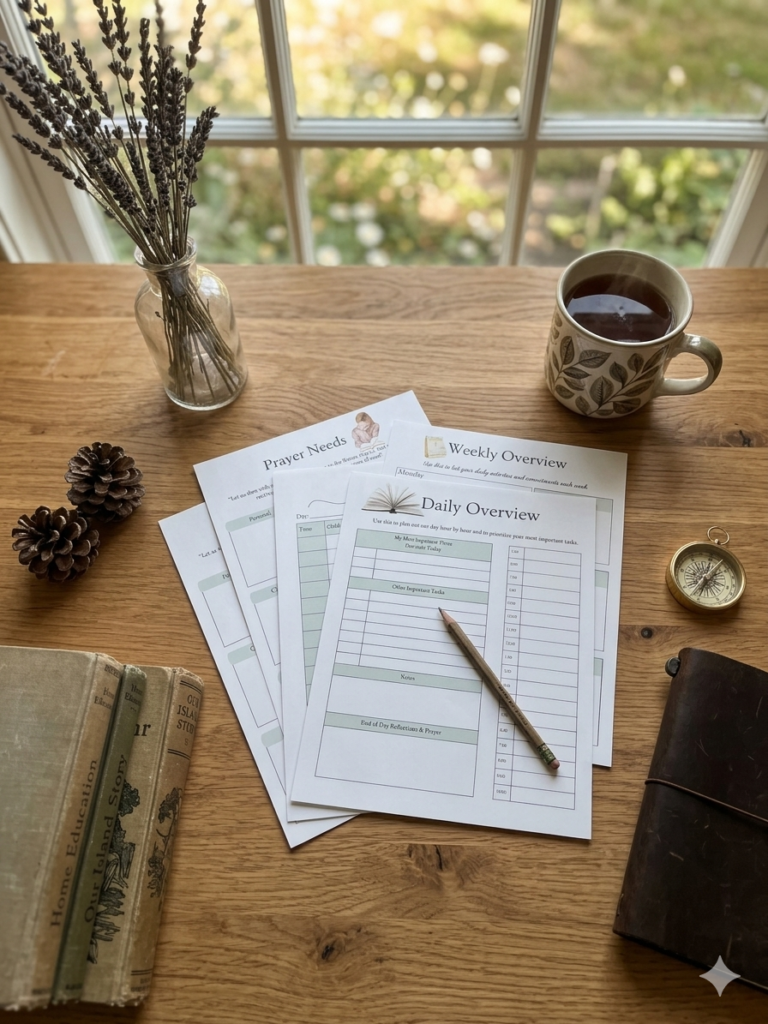
That’s why I created a simple, free Morning Rhythm Starter Kit. This guide is designed to be the first step toward building a Charlotte Mason homeschool schedule. It helps you clarify your mornings, establish a predictable flow, and begin laying the foundation for a full lesson-based timetable—without pressure or perfection.
If you’re ready to move from survival mode to a calmer, more intentional homeschool day, you can download it below and get started with a homeschool rhythm today.